UK to US GPA Calculator
Turn UK percentage marks or degree classifications into an equivalent US 4.0 GPA — weighted by credits, course by course.
Conversion scales vary between US institutions — this tool uses a widely referenced UK-mark-to-GPA scale and gives a close estimate, not an official transcript evaluation.
If you studied at a British university and now need to apply somewhere that grades on a 4.0 scale, you’ve probably hit the same wall everyone else does: the UK doesn’t use GPA. It uses percentages and classifications like First Class or 2:1, and neither of those means anything to a US admissions officer or an American employer’s HR system.
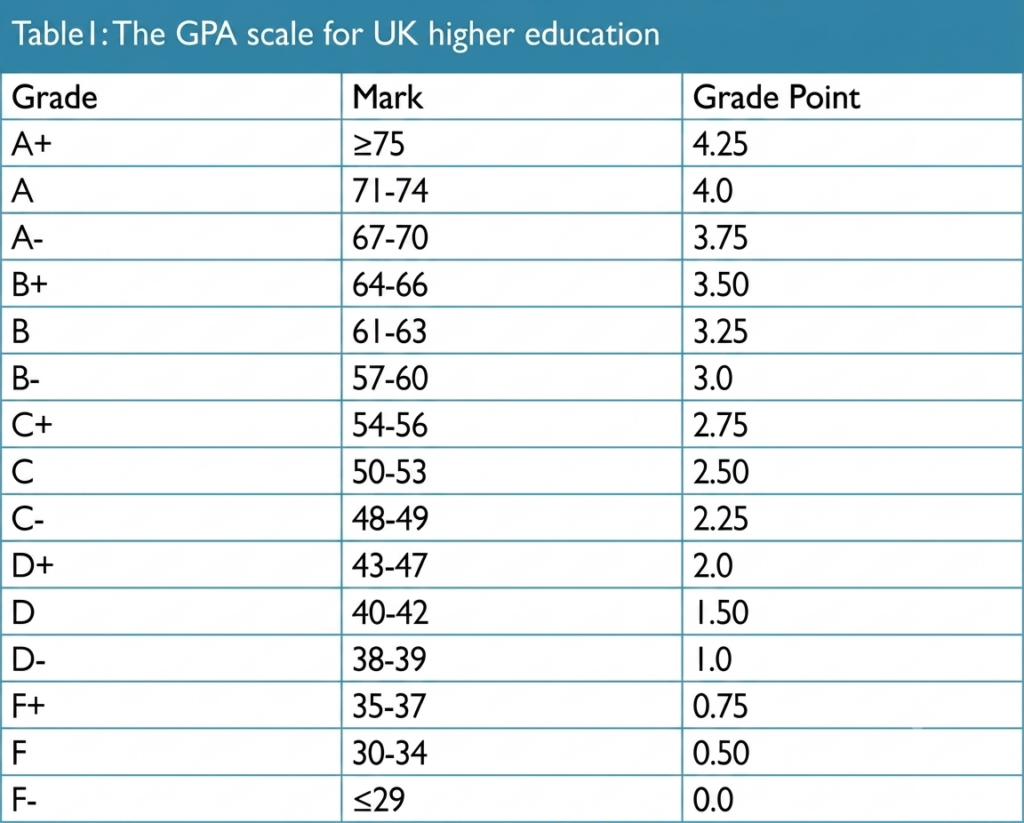
This guide walks through the UK grading system, how it maps onto a 4.0 GPA, and where the official conversion tables come from. There’s also a UK GPA calculator at the bottom of this page if you just want the number and can skip the explanation.
Why UK Grades Don’t Translate Directly
UK universities mark work as a percentage, usually somewhere between 40 and 90, and then bundle the final average into a degree classification. A 68% isn’t “bad” the way a 68% would look on a US transcript. In the UK system, anything from 60 to 69% is a 2:1, one of the two most common outcomes for a good honours degree, and plenty of strong students finish there.
That’s the core problem. US GPA scales assume a percentage-heavy grading culture where 90%+ is common and a 70% is a C. UK grading is compressed at the top: it’s genuinely difficult to score above 85% in most humanities and social science subjects, and a First Class mark (70%+) is treated as excellent, not average. Run a UK percentage through a straight US conversion table and it comes out looking worse than it is.
The UK Degree Classification System
UK undergraduate honours degrees are split into four bands, each tied to a percentage range:
| UK Classification | Percentage Range | Common Shorthand |
|---|---|---|
| First Class Honours | 70% and above | 1st |
| Second Class Honours, Upper Division | 60% to 69% | 2:1 |
| Second Class Honours, Lower Division | 50% to 59% | 2:2 |
| Third Class Honours | 40% to 49% | 3rd |
| Pass (no honours) | Below 40%, varies by institution | Pass |
Postgraduate taught masters degrees use a similar but not identical scale, usually Distinction (70%+), Merit (60-69%), and Pass (50-59%), with exact boundaries set by the individual university.
UK Percentage to GPA Conversion Table
There’s no single universal formula, because WES, individual US universities, and UK institutions each publish slightly different tables. The one below reflects the most commonly used mapping, close to what WES (World Education Services) and most US graduate admissions offices apply for UK-educated applicants:
| UK Percentage | UK Classification | Approx. US GPA (4.0 scale) |
|---|---|---|
| 90-100% | First Class | 4.0 |
| 80-89% | First Class | 4.0 |
| 75-79% | First Class | 3.9 |
| 70-74% | First Class | 3.7 |
| 65-69% | 2:1 | 3.3 |
| 60-64% | 2:1 | 3.0 |
| 55-59% | 2:2 | 2.7 |
| 50-54% | 2:2 | 2.3 |
| 45-49% | Third | 2.0 |
| 40-44% | Third | 1.7 |
Treat this as a strong estimate, not a legal document. Some US schools flatten the whole 70%+ range straight to a 4.0, on the reasoning that a First is a First regardless of whether it was a 71 or a 91. Others use a sliding scale like the one above. If you’re applying somewhere specific, check whether that institution has its own published UK conversion policy before you rely on any calculator, including this one.
First Class GPA Equivalent
A First Class Honours degree (70%+) is the UK’s top classification, and it’s almost always treated as GPA-equivalent to a 3.7-4.0. Most US graduate programs and employers that recognise UK degrees will read “First Class Honours” and mentally file it next to “summa cum laude” or a 3.8+ GPA, even without doing the percentage math.
The exact number matters more for competitive scholarship or PhD applications, where admissions committees compare your converted GPA directly against domestic applicants. A 71% First and a 95% First both round to a 4.0 on most flattened conversion scales, but a sliding-scale calculator will show the 71% closer to 3.7 and the 95% at a full 4.0. If your percentage is on the lower end of First Class, it’s worth mentioning your class rank or percentile alongside the raw number, since a 71% at a UK university graded on a tough curve can represent a much stronger academic performance than the number alone suggests.
UK 2:1 GPA Equivalent
A 2:1 (60-69%) is the second-highest UK classification and by far the most common outcome for UK honours graduates, roughly half of all UK undergraduates finish with one. On a 4.0 scale, a 2:1 typically converts to somewhere between 3.0 and 3.3, roughly a B+ to A- range in US terms.
This is where a lot of UK graduates undersell themselves on US applications. A 2:1 sounds like a “B” grade if you translate it literally, but it’s actually a strong, competitive result in the UK system, closer to a solid A-/B+ student than a middling one. If you’re filling out a US application form that asks for GPA, use the converted number (around 3.0-3.3) rather than trying to explain the percentage directly, since most admissions readers won’t have UK grading context.
How US Universities and Employers Read UK Grades
Three things typically happen when a UK transcript reaches a US institution:
- Credential evaluation services convert it for you. Services like WES, ECE, or SpanTran take your UK transcript and issue an official US-equivalent GPA. Many US graduate programs require this for international applicants, and the resulting number is what actually goes on your application.
- The admissions office runs its own internal conversion. Some universities have an internal table (similar to the one above) and calculate the GPA themselves once they receive your UK transcript.
- The classification is read as-is. For less formal contexts, like a cover letter or LinkedIn profile, employers with any UK hiring experience will just recognise “First Class Honours” or “2:1” without needing a converted number at all.
If you’re applying to a US graduate program, check the specific application instructions before assuming you need to submit a self-calculated GPA. Some schools want it, some want the raw UK transcript and will convert it internally, and submitting the wrong format can slow down your application.
Using the UK GPA Calculator
The calculator on this page takes your UK percentage or module marks and converts them to an estimated 4.0-scale GPA using the sliding-scale table above. It’s built for:
- Students preparing a US grad school or study-abroad application
- UK graduates applying for jobs at US-headquartered companies
- Anyone who just wants to know “what would my degree be in GPA terms”
Enter your overall percentage, or individual module marks if you want a weighted result, and the tool returns your estimated GPA along with the matching UK classification. It’s an estimate built on the standard conversion tables, not an official credential evaluation, so treat the result as a strong reference point for applications rather than a substitute for a WES or ECE report where one is formally required.
Frequently Asked Questions
Is there an official UK to US GPA conversion? No single official conversion exists. WES and individual US universities each publish their own tables, and most land in a similar range to the one in this guide. If an application specifically requires a WES evaluation, use that number over any calculator result.
What GPA is a UK First Class degree? Roughly 3.7 to 4.0, depending on which conversion table is used and how the underlying percentage breaks down within the 70%+ range.
What GPA is a UK 2:1? Roughly 3.0 to 3.3, broadly equivalent to a US B+ to A-.
What GPA is a UK 2:2? Roughly 2.3 to 2.7, broadly equivalent to a US C+ to B-.
Does a UK master’s degree convert the same way? Not exactly. UK masters grading uses Distinction, Merit, and Pass bands rather than the undergraduate honours classifications, and conversion tables for postgraduate degrees differ slightly from the undergraduate one shown here.
Can I just tell a US employer my UK classification instead of converting it? For job applications, yes in most cases. Many US employers, especially larger companies with international hiring experience, understand UK classifications directly. Conversion matters most for formal academic applications that specifically ask for a GPA figure.