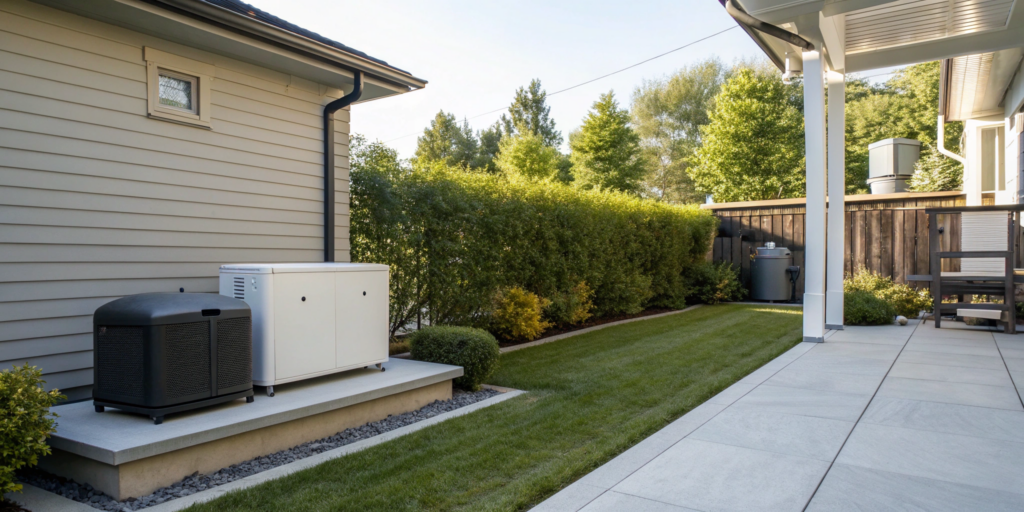
When the grid went dark during a February cold snap in Texas, some homeowners ran gas generators for days while their neighbors quietly rode out the same blackout on stored electricity. Both kept the lights on. Months later, though, when the fuel receipts and utility bills came in, the two groups had very different stories to tell.
That’s the real question behind backup power. It isn’t “which one works” — both do. It’s the one that earns its keep over ten or fifteen years.
The upfront math favors generators
A standby generator — a permanently installed unit that switches on automatically when the grid fails, usually burning natural gas or propane — is still the cheaper entry ticket. Commonly cited installer estimates put a full installation somewhere between $7,000 and $15,000, depending on size and gas hookup. It refuels itself as long as the pipeline or propane tank holds out, which makes it hard to beat during a multi-day outage.
But that price tag comes with recurring costs generators rarely advertise: annual servicing, oil changes, and fuel. There’s also a safety footnote worth taking seriously — the U.S. Department of Energy and public-health agencies consistently flag carbon monoxide from improperly placed generators as a leading cause of outage-related poisoning deaths.
What a battery does that a generator can’t
A home battery stores electricity — from the grid, from rooftop solar, or both — and releases it on demand, silently and with no emissions. The distinction that matters for payback is simple: a generator only creates value during an outage, while a battery works every single day.
That daily role is where the economics shift. In regions with time-of-use pricing, a battery charges when power is cheap and discharges during expensive peak hours. Paired with solar, it banks midday surplus instead of exporting it for a low feed-in rate. According to BloombergNEF, lithium-ion pack prices have dropped roughly 90% over the past decade, which has moved residential storage from a luxury purchase toward a practical investment.
Generators, meanwhile, mostly sit idle. According to the U.S. Energy Information Administration, the average American customer lost about five and a half hours of power in 2022 — painful when it happens, but a sliver of the 8,760 hours in a year. A machine that only pays off during those hours has a narrow window to justify its cost.
Where each option actually wins
The honest answer depends on the property:
- Long, frequent outages in cold or cloudy climates favor a generator, since a battery can drain within a day with no sun to recharge it.
- Rural homes facing days-long blackouts lean on a generator or a hybrid setup that combines both.
- Suburban homes with solar and time-of-use rates favor a battery, which earns money in the stretches between outages.
- Anyone wanting silent, low-maintenance backup favors a battery.
For higher-demand households, capacity becomes the deciding factor. A single-phase all-in-one system in the 10–12 kW range — enough to run a well pump, HVAC, and a full kitchen at once — closes much of the gap with a mid-size generator while adding savings the generator can never produce. Units like ESYsunhome’s HM10 and HM12 pair that output with app-based energy monitoring, so a homeowner can watch exactly how much the system offsets each month rather than guessing.
The ten-year view
Run the numbers past the install date, and the comparison flips. A generator’s cost mostly grows — fuel, maintenance, the occasional repair. A battery’s cost mostly shrinks, chipping away at peak charges and soaking up solar that the household would otherwise sell cheaply. Neither is universally right, but the “pays off” framing tends to reward the machine that’s working on the 8,755 hours a year the lights stay on.
For homeowners weighing that trade-off, lining up capacity against daily-savings potential — the kind of side-by-side view ESYsunhome’s residential storage lineup is built around — usually makes clear which way the long-term math leans.